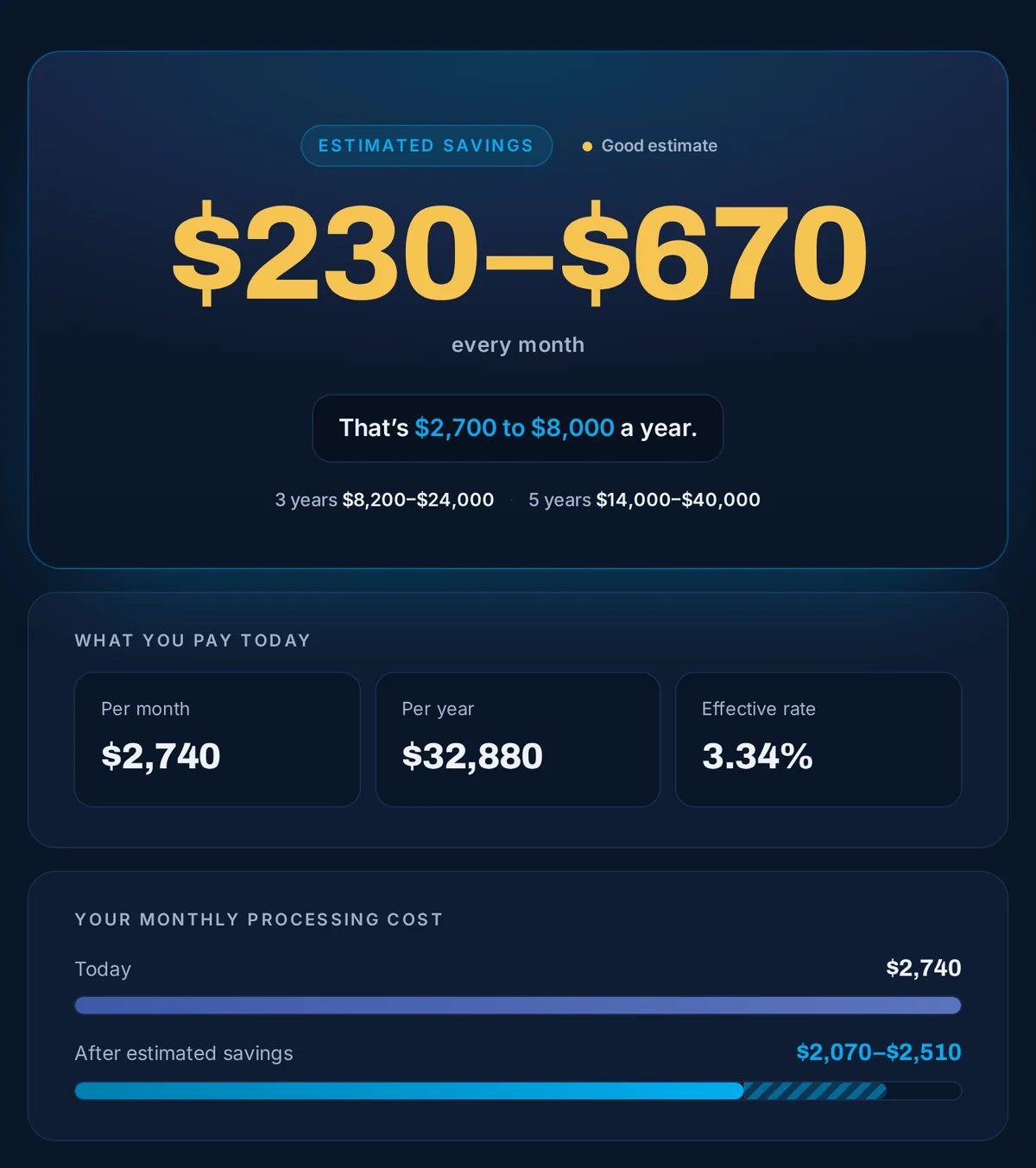
SaviorPay sets up card processing for your business and explains, line by line, what it costs. Before anything else, we will review the statement you have today.
Add up every fee on a monthly statement and divide by your card sales. That is your effective rate: the real cost of accepting cards, whatever the pricing model calls itself.
It is the first thing our analysts work out from your statement, and the figure every comparison should start from.
Total fees for the month, including monthly and per-transaction charges
Interchange-plus and other pricing models, compared
Cash discount programmes, where they fit and the rules allow
Every fee named in your quote before you sign
Pricing depends on your business, card mix and volume, and is confirmed in writing in your quote. We do not promise savings before we have seen your statement.
Pricing structures
Six ways to price card payments. We’ll set up the one that fits.
Interchange Plus, Cash Discount, Convenience Fee, Tiered, Flat Fee or Dual Pricing: SaviorPay sets up and supports all six. We’ll walk you through how each one works and help you choose what makes sense for your business and your customers.
01
Interchange Plus
Your statement shows the card networks’ actual cost and the processor’s margin as two separate numbers.
Card costs covered by
Your business
A good fit for
Established businesses that want to audit every line
Rules to know
What you pay moves month to month with the cards your customers use, since premium rewards and corporate cards cost more to accept than debit. Ask any provider to put their margin in writing.
02
Cash Discount
The cost of card acceptance is built into your listed prices, and customers paying cash get money off.
Card costs covered by
Built into your listed prices
A good fit for
Shops, counters and service businesses with plenty of in-person cash sales
Rules to know
Card network rules and state laws apply. Customers have to be told clearly, with signs posted at your entrance and where they pay. We confirm it’s allowed for your business and state before we set it up.
03
Convenience Fee
A separate fee for customers who choose an optional way to pay, such as online or over the phone.
Card costs covered by
Customers who pick the optional channel
A good fit for
Schools, utilities, government offices and property managers
Rules to know
It only applies to a payment option offered in addition to your normal one, and customers must see it before they pay. Each card brand sets its own limits, and some business types and states restrict it further.
04
Tiered
Each sale is placed in a qualified, mid-qualified or non-qualified bucket, and each bucket has its own rate.
Card costs covered by
Your business
A good fit for
Businesses checking a current tiered plan against other options
Rules to know
Your provider decides which bucket each sale lands in, which makes this the hardest of the six to follow on a statement. If you’re only quoted the lowest bucket, ask how much of your volume usually falls into the higher ones.
05
Flat Fee
The same rate on almost every card sale, sometimes with a small charge per transaction.
Card costs covered by
Your business
A good fit for
New or lower-volume businesses that want simple budgeting
Rules to know
The simplicity comes from averaging: an inexpensive debit card is billed the same as a premium rewards card, and the margin isn’t broken out. Check your effective rate again as your sales grow.
06
Dual Pricing
Every price is shown two ways, cash and card, and customers pay the one that matches how they check out.
Card costs covered by
Customers who pay by card
A good fit for
Restaurants, retail and service businesses that want pricing out in the open
Rules to know
Card network rules and state laws apply. Both prices need to be clearly shown on menus, tags or screens, with signs where customers will see them, and your POS has to display and print both correctly.
Not sure which one you have today?
Send us one recent statement and we’ll show you what your current setup is really costing you.
Your pricing depends on your business type, card mix and volume, and every fee is confirmed in writing before you sign. Card network rules and state laws apply to cash discount, dual pricing and convenience fee programs.
Statement review
From one statement to a clear answer.
01Send a statement
Upload one recent monthly processing statement. No obligation.
02We read every line
An analyst works out your effective rate and what each fee is for.
03You get a straight answer
Either your pricing is fair, or we show you where it could be lower.
04You decide
If switching makes sense, you get an itemised proposal. Nothing changes unless you say so.
Questions worth asking
Do I have to switch to get a statement review?
No. The review is free and there is no obligation. If your current pricing is already competitive, we will tell you.
What do I need to send?
One recent monthly statement from your current processor. A PDF or a clear photo of every page works.
Can you guarantee I will save money?
No one can honestly promise savings before reading your statement. We tell you what we find, including when your pricing is already fair.
What is a cash discount programme?
Under a cash discount programme, your posted prices cover the cost of card acceptance and customers who pay with cash receive a discount. Card brand rules and state laws apply, so we only recommend it where it is allowed and suits your customers.